
Hosted on Acast. See acast.com/privacy for more information.
[00:00:00] The battle for the mind of North America will be fought in the video arena. The television screen is the retina of the mind's eye. Therefore, the television screen is part of the physical structure of the brain.
[00:00:19] Alright, welcome to episode 32 of The Outer Reels. I'm Jason, with me as always is Sam. Here we are. Happy official New Year. I know we've had a few episodes out, but this is our first true recording for the year 2025. There you go. Happy New Year.
[00:00:46] This week we watched The Psychic or... Oh my God, how many other titles of this movie are there? There was Seven Notes in Black. I think the version I watched was called Murder to the Tune of the Seven Black Notes. Yeah, also the one that I have was Setti Note in Nero. That's the one on... I miss the old logo Tubi? Yeah, I do miss the old Tubi logo. Oh, look at that gloss you got there.
[00:01:16] Yes, we have matching glasses. So, while I was in San Francisco, Sam bought me some lovely gifts at Super 7 and I'm drinking from my Snake Eyes pint glass right now as we see. Yeah. But yeah, for you guys, I don't know if you've seen, but Jason came down over the break to visit San Francisco. We had a good time. We toured around, saw some movie locations. It was a lot of fun. Launched our own beer. We did launch our own beer. Which is pretty awesome through Aaron over at Hopos, which is a little brew pub down here.
[00:01:44] And I'm actually drinking our beer tonight. I picked up a couple cans from his place before he came here. So, that means Sam will be inebriated by the end of this recording because this stuff's 8%, folks. It was a double IPA that he brewed and it's delicious. It's smooth. It's malty. It's pretty dangerous because it goes down pretty good. Yeah, exactly. It is tasty, though. I was glad I was able to have some. No, it was a good time.
[00:02:08] We had a fun time and we've got a lot of stuff in store this year, especially we have something cool. We're going to have a special director who's going to come on. We've got some people and guests and stuff, so we're having a good time. Hopefully, ramping things up a little bit this year. It should be fun. Yeah. Back to the topic at hand. The psychic or seven notes in black or yada, yada, yada. So, Sam, I'm thinking you hated this movie. It's not a good movie, Jason. It is a good movie.
[00:02:38] It is rather slow, though. Yeah. So, this is from 1977. And 77 is a great year. A lot of great things happened. Unfortunately, also the year where Elvis died, which isn't a great thing. But some good stuff came out of 77. This is directed by Lucia Fulci, who's certainly no stranger to our listeners. But I feel like he falls a little short on this compared to what he had coming up in the tank afterwards.
[00:03:05] Well, this is definitely probably toned down compared to some of the other things he's going to be known for, shall we say. Yeah. So, you're saying two years after this, he did Zombie, which is probably his movie that everybody references. Great score and everything else. But I think his, like, accepted best film is New York Ripper, which was two years later, three years in 1982. For the listeners, probably tell me, what is this movie about, Jason?
[00:03:34] So, the gist of it is you have Jennifer O'Neill, who has just married. She's, I guess she's American. I mean, I think she's actually American. But she's just married this wealthy Italian guy and has, turns out she's psychic. She's getting these visions. So, at the start of the movie, she's, well, not quite the start. Start, we'll get to that.
[00:03:57] But early in the movie, she has this vision of a dead woman and a hole in the wall of this mansion, I guess, that she's staying at or this guy's estate. So, basically, at the beginning of the movie, her husband flies off somewhere and she decides she's a designer and she's going to fix up his house and do it secretly. But as soon as she walks in, she starts having all these visions nonstop. So, that's the gist of it. There is a twist with her visions coming. Yeah. A little later in the movie. Yeah.
[00:04:25] I think my elevator pitch for it would be. I've stopped doing elevator pitches at this point, Sam. You should just accept that. No, I mean, but these are fun, right? Because this is, they're fun because trying to concatenate everything into the elevator pitch and make it sellable. You know, I would say that it's about a woman who has premonitions and it's a mystery crime solving drama. Except the problem is, is that that seems more something like episodical based.
[00:04:53] I don't think you need 90 minutes to sell this story. No, I mean, there is definitely, as I alluded, this is slow. So, there is definitely not enough story for the amount of time we have. So, there are a lot of slow plotting shots. I mean, it's a product of its time, too. It is the 70s. In the 70s, they took their time. So, it's not like you don't have a lot of the rapid fire quick cuts and stuff you have in this. It's slow.
[00:05:24] But, yeah, there's not a ton of story here. It's very quite simple. Yeah. And, and I will admit, I did fall asleep at one point. So, I think I only missed a minute or two. I did not go back. Okay. Yeah, no. Well, as my due diligence, I sit down and I lock in and watch these damn things. And this is a huge clear and cut case if we watch these movies so you don't have to.
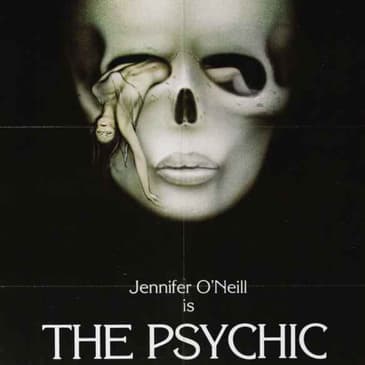
[00:05:51] Because, on the surface, when you suggested this movie to me, I was attracted to it. I was like, I love the poster. Sweet poster. Sweet poster. It's a very cool design poster. It has almost like a Giger feel to it, even though. Yes, it does. Yeah. Very classic looking poster. And then the trailer, I was all in on too. The music was great. It had a cool vibe to it. It was a short, like 60 second trailer. Those trailers used to be quite short for those movies. And everything was sort of adding up. And I was like, this could be cool.
[00:06:21] And, you know, the psychic component was appealing. As we've talked before, I mean, you know, I think psychic movies in general are just, there's so much that can be done there. And so much can be had with other movies that are psychic movies. Like when I think about other psychic films. Supai. Yeah, there you go. Which we covered during our tour of Japan, which, as we discussed, could have been an awesome movie.
[00:06:47] Because a great premise, which was, you know, a group of psychic spies that work for the government. Just super fun. Just not executed very well with budget and everything else. But the genre of psychic films, I think, can go so far and wide. And when I think of my favorite psychic film, I'd have to say The Mouth of Madness. John Carpenter, Sam Neill. I mean, it might be some people might be like, well, it's not sad. But there's a lot about it to that movie.
[00:07:17] It's many layers to that onion. And I think it's pretty good. Yeah, I need to rewatch that. It's been way, way, way, way too long. So I don't think I've seen that since the 90s. It's such an underrepresented movie as far as Carpenter stuff goes as well. Sam Neill's incredible in it. There's some, there's great stuff. There's just everything. Again, the music is incredible. But, you know, aside from Supai, where do you land in the world of, like, psychic movies? Is there another one that stand out for you in the genre? No, not offhand.
[00:07:47] I mean, the cream of the crop will be Akira. Wow. So, which I love. In fact, Akira is the only thing I think I've owned in physical media in every, almost every conceivable fashion. Had the VHS tape. Had a DVD. Had a Blu-ray. Have a 4K Blu-ray. I did not have a LaserDisc. I don't know if it made it to LaserDisc. I doubt it ever made it to Betamax. I was going to ask if you had the VideoDisc. But, yeah, it certainly came out after those.
[00:08:17] Yeah, that is funny. It in 2001 are the two movies I've done that with. I feel like the one, the movie that I've had across the gamut of all things and the most copies of is Army of Darkness. Like, I have so many damn copies of that. Like, just DVDs alone, I have, like, five of them. But then there's the Blu-rays and then there's the VHS. Like, there's so many different, like, it's kind of almost a joke among collectors of how many different versions of Army of Darkness exist on the same format. I do digress.
[00:08:46] But, you know, I was thinking about when I was watching this, I was thinking about psychic films and other ones that I like. And Scanners has got to be up there because I think that's... Oh, yes, of course. I mean, that's the, you know, movie, you know, the most memorable for the masses, I think, has to be that. I was also thinking Dead Zone. Yeah. Dreamscape's another one that comes to mind. I really like Dreamscape. Yeah, Dennis Quaid. Need to watch that again. That's a good movie.
[00:09:15] Yeah, it's been a long time since I watched that. But I just remember there was an episode of Sliders where they had something similar. Love that show. Yeah, I know. I know you do. I enjoyed it for the first couple seasons. But there was an episode where they went to a world where these, like, nerds could enter people's dreams. A little bit of Dreamscape there. Yeah. Firestarter and Carrie are somewhere along those components, too. Yeah, pyrokinetics, but... Or telekinetics. Yeah. But, yeah.
[00:09:40] And then the one that I do want to see that I haven't was Toby Hooper's Spontaneous Combustion. It's from, like, the late 80s, and I never saw that. No, I never saw that either. Yeah, I feel like I owe it to him to see that. And then there was that... What was that? Nick Cage movie? Seven Seconds or Seconds or whatever it was called? No, it was about, like, decoding numbers. It was Knowing. Oh, Knowing. Yeah. But he did another one where he could see, like, so many seconds into the future as well. That's what I was trying to think of. Right, right. Knowing is actually pretty good.
[00:10:10] That's Alex Proyas, the same guy that did Dark City. Oh, yeah, yeah. That's right. Yeah. Yeah. We both love Dark City, but I love Knowing. Yeah. No, I remember being surprised by it. It's that classic dead genre of, like, $20 million films that we just never get anymore. Yeah. Well, and the cool thing about Knowing is it does not go where you think it's going to go. No. Like, at all. You don't see that ending coming. Which is a great play on the title, really. Yeah. Yeah. Back on this movie...
[00:10:38] Sorry, we're getting us way off track here. But back on The Psychic from 77. So, this is written by Dardano Saccetti. And, again, I apologize because I'm butchering these names. But we would know him as the writer from 1985 Demons. The Demons, everybody loves that. But the story for this movie was loosely based on a novel from 1973 that was written by Viri Razzini.
[00:11:07] And it was titled Terrapia Mortel, which translates to Deadly Therapy. So, this was actually only three years later that this was a movie from, apparently, a pretty good novel that was a bit of a hit. Hmm. Yeah. There you go. I had no idea. Yeah. I know you did not like this, but I did, to a degree. Like I said, it's really slow, so it's a little pondersome. There were a lot of times where I thought...
[00:11:35] Because, again, kind of like with the Supai or Espy, however you want to say it, they would show you what's going on with the eyes. So, they do, like, zoom in on the eyes. And the eyes get so frequent in this movie that I felt like I was watching the Matt Reeves Batman movie again. It's like... Which, as everyone knows, I'm a comic nerd. And I did not particularly enjoy the Matt Reeves Batman movie. I think it's a beautiful looking movie.
[00:12:05] But I didn't need to be watching Robert Pattinson just kind of stare brooding that much for that amount of screen time. I'm not going to mention the fact that I worked on that movie. Yes. So, there was some stuff that was dropped out of there, but that's for another conversation. But I think... Yeah. Hey. What did I say?
[00:12:34] 88 minutes. And there's about 57 minutes of story in it. It felt long for how short it was. Yes. Because it stretches out a lot. They spent a lot of time. But speaking of looks, though... The DOP on this was Sergio Savatti. And you would know his work from the incredibly beautiful 1966, The Good, The Bad, and The Ugly. Nice. What I'm getting at it here is... And I use the term a lot.
[00:13:00] It's like, we have some pedigree here in this movie from all corners coming in. Like, actually really good filmmakers. It still never hit the mark. And I don't know if it was a budgetary or a time constraint. I'm going to say it didn't hit the mark for you because if you go to Rotten Tomatoes, this is 100%. What? Now there's only five reviews. Oh my God. But the popcorn meter, which is the user, that's at 70%. Wow.
[00:13:29] You go onto Letterboxd and everyone's giving this four, four and a half stars. Wow. This is a really loved movie. And I get it. I can kind of understand it. It's all about tone, the visuals. And again, for me, it doesn't quite work either. It works more for me than it does for you. It is well shot. I mean, for obvious reasons, as we now know. It's biggest crime is it's just slow. There just needs to be a bit more to it. I mean, the basic gist of it is she's psychic.
[00:13:57] You think she's got a premonition that there's this body in the wall of her husband's house. And it turns out that's true. But as the movie goes along, you find out that what she's seeing is actually the future. So she's not getting glimpses of the past. It's not like the dead reaching out to her. She is seeing the future. So and that's that's sort of the twist that comes about two thirds of the way through the movie. I think that is what needs to be in your elevator pitch to sell this movie, because that's the hook to me.
[00:14:27] She sees stuff. But what you realizing it is the future. My feeling about this when I saw this, I was like, the better version of this movie is the eyes of Laura Mars. Yeah, I never actually saw it, but but I do know of it. What I really liked about this is eyes of Laura Mars is 78. So I don't want to detract from this film and say this film is a knockoff of eyes of Laura Mars. 100%. Even the poster of eyes of Laura Mars is very similar to this.
[00:14:57] But what's really cool about it, I would highly recommend this film to anybody actually over this movie. We're watching the psychic. I would say just go straight and check out eyes of Laura Mars. So it was directed by Irving Kershner and is written by John Carpenter. And that's why I'm all about it. Right. And not many people know or whatever. Faye Dunway and Tommy Lee Jones. This is a great movie.
[00:15:20] But what it's about is that she's a photographer and she is a fashion photographer and she's doing these like edgy fashion shoots where there are women who are like, you know, laid on the ground as if they've been murdered and they're wearing this dress and everything else. But what ends up happening is these crime scenes start showing up and they're staged exactly how she staged her photo shoot, you know, days or a week prior.
[00:15:49] And what ends up happening is like she is having these premonitions of these murder scenes and now she's making them up and staging them for what's to come. And then so they start using that as like, well, if this is your next premonition, like, you know, how do we solve this next crime? And it's a really fun idea, but maybe something we should really cover when we finally do a series in America, because I feel like it probably isn't that well known.
[00:16:16] But what's interesting about the history of that movie and how it came about was, you know, this is after Dark Star. So which was Carpenter's first movie, but that was his student film that he made in college. And it wasn't even a full hour long TRT. It was like a 40 minute, 40 something minute TRT at the time. And a studio picked it up and gave him more money and said, hey, if you finish this, we'll give you more money to shoot more. Turn this into a 90 minute movie so we can run it in the theater. And Jack Harris was the producer on that.
[00:16:47] And right afterwards, after he's essentially responsible for turning Dark Stars, John Carpenter's Dark Star student film into a feature film and getting him on his way. And it made some money. And he sort of went to John and said, do you have anything else? And John had written an 11 page treatment for this movie called The Eyes of Laura Mars. And then Jack Harris optioned that from him. At the time, it was just called Eyes. That was just the name of the story.
[00:17:15] But that's how it all kicked off and got going and how Carpenter got screenwriter credit and everything else. But I mean, you know, those are the days when you could option an 11 page treatment, you know, like just everything's so good. Yeah, it was a different time as we know. Yeah. And they shot that in the fall of 77. And I believe this movie, The Psychic, they were shooting this in September of 76. So completely disconnected for how similar they would be.
[00:17:42] On paper, you could probably say somebody saw this movie and was like, or Carpenter saw this. And like, that's a cool idea, you know, and took it a bit further. But I don't know. Worth mentioning. There you go. Yeah. No, I completely forgot all about that movie. So it's kind of like we don't really get a lot of psychic movies anymore. You know, it was like the 70s was, of course, big for all the paranormal stuff. It was a hot topic.
[00:18:06] And it was also something that's achievable through shooting something with some, you know, musical cues and audio stings. Yeah. And that's all you need. It wasn't a big VFX thing. I mean, to Supai's credit, it has like every time you see their eyes, this movie has none. This movie has no actual camera effects, no optical visual effects in it. It has one great gag at the beginning, which I'm like the only good VFX shot in the whole movie.
[00:18:36] But otherwise, this is truly a movie made out of nothing. I mean, it's considered a gala film or whatever they call them. I saw that term. I'm not familiar with what it actually means. Yeah, there's a bunch of the Gallo film, which is genre of murder mystery fiction that often contains slasher thriller, psychological horror, psychological thriller, sexploitation and less frequently supernatural horror elements. Thank you, Wikipedia.
[00:19:06] It is one of those. And I was actually while you were talking about it, reading up on the eyes of Laura Mars and they said it's an American example of that kind of film. Very good. So a lot of people think of it as being that, which it probably is, especially if this is that. I mean, this is at its heart is a murder mystery. Yes. There is a dead body and she's trying to figure out who it is. She's having psychic visions. But again, what, you know, she thinks she's having psychic visions of the woman murdered.
[00:19:34] Like at one point she says, it's this old woman who's murdered. I saw her. I saw her dead. And then the cops get a hold, you know, the body and do forensic analysis on it and say like she was like 25 when she died. Right. Woman's like, no, this can't work out. So, you know, as the movie goes along, we find out she's having flashes of the future. She knew about the hole in the wall because she cut it open herself. She knew the dead woman she stumbles across later. Yeah.
[00:20:00] So it's, it's again, like that's kind of the cool twist, the whole thing, which is clever. And it's well done. But again, there's just not enough here. And like I said, I was nodding off. The opening pulled me right in because like, like I said, I'd looked at the poster. I watched the trailer and I typically don't watch a trailer before I watch a movie. But I didn't watch the trailer. I do enjoy watching them in retrospective.
[00:20:23] But before I watched it, I pulled up the trailer for some reason and it kind of hooked me and sucked me in because like I said, it was a 60 second trailer. Everything good. But the opening sequence and there's a title card and it's set on October 12th in 1959. Like 1145 a.m. It's like it's oddly specific. Yeah, it is. And our main character, Virginia Ducci and played by Jennifer O'Neill.
[00:20:51] Her, her mother, this is her, she's in like a Nash Metropolitan too, which are great. There's such cool little cars. She pulls up and jumps off the cliffs, off the door of her cliffs. And meanwhile, Virginia is in Italy with a school group and sees all this in her mind. And when her mother dives off the cliffs, there is that. The mannequin is awesome. This is going on the Instagram, dude. This is my only hook for this whole movie.
[00:21:20] I knew it when you saw it because like they're showing the face scraping across the cliffs. And it's just this latex sheet pulling off the mannequin. It's great. And it's cut. It's like triple cut and it's back and forth and back and forth. It's pretty hokey, but it's very enjoyable. But that's the thing. We're intercut and so it shows you the same time elsewhere. And she's essentially, it's not by location, but she's just seeing it happen. The daughter. Yeah. Yeah. She's basically going mom and like the nuns that are with her.
[00:21:50] I think there were nuns. Um, like what's wrong child. Um, but this is Virginia Ducci played by Jennifer O'Neill. And I thought it's interesting because we would all know her as Kim from scanners, which is again, yes, the big key psychic movie. So I'm like, did she get herself top cost into this? Like, is this why she was in scanners? Like, I don't know. Well, there's just five years difference between the two, but still it's, um, you know? Yeah.
[00:22:17] I think, I think this movie is pretty early in her career though, isn't it? So, oh, she was in poltergeist, poltergeist, the legacy. Yeah. Um, oh, I'm wrong. No, she, uh, had done quite a few before, um, for the site. There you go. Uh, and she's also in a force of one. She's first billing on the force of one above Chuck. Well, it's cause she was, I mean, she's pretty famous, right?
[00:22:45] So she was a model and actress and, um, yeah, but it's, isn't his first, is it his first, isn't it? Um, oh no, I guess not. Breaker, breaker, way of the dragon. Um, he'd been, but it was probably his first big one. He was getting bigger. Yeah. Octagon followed a year later. Yeah. None of those are top dog from 1995. Dude, I love police buddy movies with dogs. Where are those movies now? Those don't exist anymore. Turner and Hooch, man.
[00:23:14] Oh God, that was so good. They tried to make a series out of it. Really? Yeah. They shot up here. It was, uh, didn't they have, uh, Tom Hanks getting it? I think I can't, I could be wrong on that. I feel like that's the genre that's completely gone away by far and wide is the buddy, the buddy movie. Like if they do exist, they're like an R rated, like hardcore comedy. If that's a thing, hardcore comedy, but yeah, like, like the, like the last two bad boys movies that they made. Yeah. There's just not these chipper, like, you know, I mean anything past Michael Bay bad
[00:23:44] boys doesn't count as far as I'm concerned. Bad boys two is a perfect film. I like bad boys more because it has tail Eoni in it, but, um, so, so then from her being a child, we sort of time jumped to her being an adult and yeah. And they don't really tell you either. You just have to make the assumption that she's now the adult version. Yeah. Cause from the child now we see her as Jennifer O'Neill, Virginia, and you're like, I assume this is who she is, but yeah.
[00:24:11] Like, I don't even think they make a reference at all to that opening scene ever. Like at all. It's just there. And there's no like cross dissolve, you know, that like, that's the time old way to like have take somebody's face across the old of them, older driving, riding bus or whatever. And it's put, put them on a, on a, like a subway train and then do a dissolve to an older Lee majors movies. So good. Talking about the last chase, by the way, which you, if you haven't seen, you should check
[00:24:38] out episode number two where we covered possibly one of the greatest unknown films that I'd never seen that Jason put me on to that. I love the last chase with Lee majors that I happened to see on TV around like 1980 or 82 or just Meredith. So great. Yes. I, I, I, I've told the story about it. Going to a Burgess Meredith talking about how sexy his airplane is. And my mom walking in wondering what I'm watching. Just listen to episode two and you'll get the whole joke. Great.
[00:25:09] Yeah. No, there's, there's nothing clear there about her becoming from a child and having this vision of her mom suiciding. And now she's an adult and she's driving out to this, uh, big old house. She has like a chateau somewhere. Why is she even going there? It's a house that she's bought with her husband. She's a designer. Yeah. Well, yeah. And I was even thinking though, like going back to the, that first scene was, um, because the more I think about it, the more I realized how superfluous it is.
[00:25:38] It just does not need to be there at all. It's, it's not necessary, but at the same time, it's, it's gotta be a good 10 minutes. Yeah. So I think that's the only reason why it exists. And it's the only VFX gag in the movie. It's entirely possible that this is a reshoot and something where the, you gotta add some gore to this movie. You gotta add something. Or, you know, we gotta put something in it to extend the time or yeah. Put a little bit of gore. Yeah. Yeah.
[00:26:03] It, it's just, it's, it's crazy that it's, it, it adds nothing to the movie other than time. No, but it's the beginning. So you don't know any better until you watch it. Exactly. Next thing you know, she's driving along with her husband in the Rolls Royce. Mm-hmm. He gets into a, like a little Cessna and she says goodbye. And then she drives off and this is where she goes to the house. Right. Because she's by herself. But like, it's, it's a weird long drive.
[00:26:28] And every time she's in a tunnel, it's like, she gets like this weird confused look on her face. And I think this is where she starts having her premonitions. They only seem to occur while she's in a tunnel. And I, to me, it looked like she's having a hard time seeing and all I could think was like, turn your headlights on. All right. Like, what's the problem? Sure. You know, it's, it's not like they had driving lights back, you know, always on driving lights back then. Yeah.
[00:26:53] She arrives at this place and it seems like she's going to rebuild it or like restored or work on it for her husband. It's their home and she's coming in as a designer to remodel it and it's going to be their vacation home or, or whatever it is. This is like her project essentially is what this is. Right. And so they bought this thing. It's like some big old chateau and she stays there for the night, but there's all these things
[00:27:19] that she sees and there's like a mirror that's cracked, you know, in a very specific way. And there's a cigarette and an ashtray. And the only reason I know these are important in the film is because of how long the movie spends looking at them. Like they're not in passing. Yeah. And they don't show it to you once. Oh my God. So many times. And yeah, you see this damn cigarette and an ashtray and you see this mirror and you,
[00:27:47] like I said, you, you see it and it's just a locked off shot of it and there's music playing and you're like, Oh, well something's happened here. And then there's a shot of the cigarette burning in an ashtray. Nothing happening here. But this is, this is 20 minutes into the movie is at this point. And she's like staring at a crack in the wall in the plaster. So it's, we should put it, it's 20 minutes into the movie and all that has happened so
[00:28:12] far is as a girl, her mom committed suicide and she said goodbye to her husband in the plane and drove to the house. Now she did get stopped by the cops on the way. I guess she passed out going through one of the tunnels and, but, but there seemed to have been no problem. And the next thing you know is to just her and a cop on the side of the road. So now she gets back at the house and that's where we have all these, she has all these premonitions and she's looking at the wall and there's a hole in it. You know, she doesn't know why.
[00:28:39] So she goes like searching around and finds like a pickaxe goes to town on this wall. She's been in this house for about 10 minutes. Yeah. Well, she technically stayed the night, but, Oh, I guess so. But it doesn't, you know, it doesn't translate at all. Like she just wakes up and she's like, I'm going to take a pickaxe to this wall. Like as slow as things are, this moves weird. Like for all the time in this movie, the moments that do move, move in, uh, like in a weird
[00:29:08] cadence, there is either these really short moments where a lot of stuff happens and then it's like spread out. It's just, it's, it's shot well, but I don't think it's cut well because I, well, I should say I never want to insult bad editing because you know, as you know, you don't know what they've been given. Well, that's it. It's like the classic case is the, you know, the classic trope is if the movie's great, you applaud the director. If the movie's terrible, you blame the editor. Yeah.
[00:29:36] So anyway, so, and I know I'm friends with a lot of editors, so, um, I know how thankless their job is because the thing is, is if the editor is doing a good job, they're, they're invisible completely. It's, you know, that's exactly it. And this movie feels like they're cutting around a lot of problems. It could be, it could be. And trying to sustain screen time at the same time on stuff they've just rolled on. So, yeah.
[00:30:04] But yeah, she's chipping away at this crack in the wall, which should be the second act by now. Like TRT wise, we should be in the second act of a movie and she's still digging into the wall of his house, this plaster. Yeah. Yeah. And, um, you know, after, and this goes on for a while because she kind of gives up at a certain point cause she hasn't done much work. And then like she gets another vision and she starts all over again and she goes at it cause I think she could, I think she tired herself out the first time and then like she's,
[00:30:32] she goes at it again and then like finds a skeleton in the wall and then calls the cops and the cops are like, so you come to this house and the first thing you do is open up the wall and you find a body like what? And she's like, well, no, I'm a designer. Well, cause she made a comment that, um, like he's like, why wouldn't you like at least consult a decorator or a designer? And she's like, I am a designer. Right. And our decorator, I think is what she said.
[00:31:01] And he's like, Oh, right. Okay. We should point out the cops in this, in this movie are like completely useless. Whatever. I mean, the first thing to do is just is, is arrest the husband for this body in the wall. And the body also is it's, it's in a weird, like kind of fetal position in this corner. Like it's not like somebody crossed it in there. It looks like somebody died in there sitting down 300 years ago and now they've completely decayed. Like the way the skeleton is staged.
[00:31:31] Yeah. Considering I think it's supposed to be about five years. Right. So, but it's a complete skeleton. Like it's, it's been in there for a hundred and, um, yeah, it is quite funny because then the cops immediately just arrest her husband and throw him in jail. And he's like, cause it's your, it's his house. So that's what they do is they basically, they almost even say like the cops are really lazy. They just take the easiest thing they can find and that's what they run with. It's like, yeah, I guess it's Italy in the seventies.
[00:32:01] I mean, whatever. I mean, still, you'd think they'd be better off than they were under, you know, fascist rule, but okay. Um, yeah, it's a, it is kind of a funny attitude. While this is happening, then she has this other permanation that looks as like a woman up in a tree and it kind of looks like a grandma version of poison Ivy from Batman. She's in like green, you know, poison Ivy was like grandma.
[00:32:30] Like that's what she would look like. It's quite the image. And we don't really know what it is, but she's like bleeding out of her forehead. And you know, now I'm like, Oh, so this is the point. So we're like 30 minutes in this movie and I'm like, okay, so I think this is a whodunit movie based around this skeleton. Yeah. It kind of is. Yeah. And that was why I was just like, damn it, Jason. I'm already committed. Hey, hey, psychic powers.
[00:33:00] It's, it's, it's sci-fi. Yeah. No, there's a skeleton that makes it horrible. That's true. So there's another gag here where she notices the cigarette brand from her premonitions. Well, because her, the, the, her sister-in-law that she's hanging out with her sister-in-law who has my favorite line in the entire movie is basically, they're trying to make a case for why they think the husband did it. Cause it turns out the body in there, like, you know, our Virginia thinks it's an old woman. It turns out it's a 25 year old woman.
[00:33:30] And then they managed to trace it to this woman who went, who disappeared five years before who was a former lover of, of Virginia's husband. Let's be clear. It would take longer than 25 years for this skeleton to look like it does. And it's, and it's been fine. Yeah. Um, yeah. So anyway, but they managed to figure out that it's a 25 year old woman. They eventually find out that it is this missing girl who is 25 years old and is the former lover of Virginia's husband.
[00:34:00] And, you know, they said basically that, that makes sense because it was probably some kind of quarrel and he killed her and hold her up in the woman. And the woman and his sister like says like, but counselor, I mean, I've had 56 lovers and I've not once have I wanted to kill any of them and I keep count, you know, that's right. I remember that line. Well, it's hard to forget. So when you, some woman who in the seventies to boot points out that she's had 56 lovers,
[00:34:25] I mean, it reminds me of her brood grandma who's had multiple. I thought the same thing, dude. I thought exactly the same thing. They're just trying to throw down. That was actually a pretty good guy. So anyway, anyway, she, that's what it is. And then, uh, Virginia notices that the cigarettes that the sister-in-law is, is, uh, smoking looks like, I think it's Gloria's her name. Yeah. Um, is the same as from her premonition. Right. And yeah.
[00:34:54] And then she asks where it came from and that's where Gloria's like, well, they're not marijuana. She's like, what kind of cigarettes are those? Well, they're not marijuana, but they're like some, something someone gets for her or something. After this discussion, there's this really long scene and I don't want to bore the listers because it's that this might've been, I think this is about where I fell asleep to where she's looking over some photos on the mantelpiece.
[00:35:22] And I just remember being like, man, these are some long shots. And we're 42 minutes into the movie right now. And all I know is that there's a stiff inside the wall and they're trying to figure out who it is. And she's looking at all these photo frames and then there's a wide shot and all of her furniture looks like boiled candy. It's got, you know, it's just like the silky with the stripes, the two-tone stuff. But I was just like, what do I learn here?
[00:35:49] And that's, you know, I just look at a movie and I'm like, where's economy of character from my time invested? You know? And it's like, what am I learning? Especially when, you know, if you're cutting something, you're like, do I learn anything here? Let's move on. Like, what do we learn from the show? What do we do? You know? And there's nothing. And as we've determined that they're filling time, there is still a mystery going on at this point too. I mean, where I have to give the movie credit is, is it all comes together. It all makes sense in the end.
[00:36:18] Like there aren't a ton of loose threads or anything. It all does gel. It's just not done well. They're just dragging that. And she keeps having all these visions and they're only depicted by sound. And this is what I was talking about earlier, where at least with Supai, we still got these like optical shots of like things being displayed in her, in their eyes. And you're like, oh, they're looking at stuff.
[00:36:45] Yeah, we get lots of shots of Virginia's eyes and things and slow zooms on them and things like that. So, you know, she's having a vision. But they're not visual effects. Like, you know, they're not like a VFX shot with things and projections or whatever. You just have to trust. I know this is the same year as Star Wars, Sam, but it's not Star Wars. They didn't have that kind of money. Jason, this is the same year as Smokey and the Bandit. That's, this is that, that is the all important film. And so many visual effects and smokey in the bed.
[00:37:12] No, it's just real men, real effects and real stunts. That's all we do. But the point is, is that after we got shown all this stuff with Supai, like, yeah, they give you the idea that like when they're thinking about something or doing a psychic gag, their eyes glow and there's this music crescendo and there's these stings. This movie. That's the difference between the Japanese and the Italians. Completely.
[00:37:36] This movie relies entirely on just hoping the audience thinks, well, it's a slow zoom on her eyes, so she must be imagining this. But, but you know that and it makes sense and it works. I mean, it, as much as you don't like it, it does, you do know what's going on. No, you're right. Yeah. Actually, that's a good point because it's been set up like that. You're right. No. It's successful. It's cheap. It's cheap. It's, it's cheap. It's lame, but it, it works. So, you know, you have to give them credit for that.
[00:38:06] No, that's a good point. After all this, I just remember looking at the running time and I'm like, okay, we're, we're 54 minutes into this movie now. I've, I've decided at this point because I, I still didn't know, but I've made the decision at this point that this is a singular murder mystery movie. You know, there, nothing else is going to happen as far as, you know, other strange things or whatever.
[00:38:35] It's all coming down to who done it on this skeleton. Really? It is. But at the same time, it's not because there's a twist to make M. Night Shyamalan proud in that the murder mystery is she's seen her own murder and she's got to figure out who does it. Except you don't know that till the end, which is unfortunate. Because I guess we should, we could probably talk about the music part when we can wait or whatever, but. Music's not terrible.
[00:39:01] I have another note that says the eyes of Laura Mars is better than this movie. But this is what I actually wrote when I was watching it. I was like, you know what? The eyes of Laura, like I'm still stuck in how much better that is as a movie. She is on still in a discovery mode where she's talking to people and about like what happened here, who this dead person is. And she's almost doing her own detective work, but it's still, it's not a hook.
[00:39:30] There's nothing. No, I know. There's nothing that has, you know, so tell me where the act breaks are because I couldn't find. Oh, I have no, no clue, dude. Like it's just, they're not there. There, there's, I mean, I mean, I guess there's, there's, there's one at 10 minutes in. Sure. You know? And then I'd say, and then it's like a really long, really, really long second act. Yeah.
[00:39:59] And then the third act would be where, um, she starts getting hunted by that other guy who like, she goes into the room and she has a vision of the knocked over sort of Beethoven head or whatever it is on the, on the piano. And there's a letter underneath on the mantle. Yeah. There's a letter underneath it. She takes that. And then the guy starts hunting her and, and, you know, she had already seen him talk to him earlier. And she's had this premonition that this guy is up to no good and he's chasing her.
[00:40:28] And then like, he basically falls to his death trying to get to her when it turns out, apparently all he's trying to do is get the letter. Yeah. She's been, she, the, the Beethoven head is a good one because when I'm like an hour into this movie, I'm like, this still feels like the first act to me. She, you know, has these flashbacks of her dead mother and all this sort of stuff. Yeah. I'd say the third act starts when she realizes what she's seeing is the future and not. And it's her. Other, other psychic visions. Right. That these, these are all tied to her.
[00:40:58] Which I think on. Which is, which leaves us with like 15 minutes left in the movie. But it's like, I think on paper, that's actually a great bit where you're like, here, it's a psychic. She discovers this body. She sees all these things. She's trying to solve it. And through the solve, she realizes that it's going to be her. Yeah. But it's never told like that as a gotcha moment. And it doesn't really build up. And then, yeah, there's a, like I said, there's this Beethoven head statue.
[00:41:28] She's having flashbacks of or premonitions of, and it's on its side. And then she goes into the room. She sees it standing up. And then she turns it on its side. And then there's like a letter in there. It's like the worst place to hide anything. Yeah. Entirely. Because it's like sticking out as well. It's like not even like entirely hidden. She also sees her dead mother again, which again, looks like grandma poison ivy.
[00:41:53] I guess the whole thing about these clues that she saw were all these disrupted things around the house, like the broken mirror and all this stuff. And she's trying to recreate these disruptions now. Like she's going around and like she goes to the mirror and she smashes it. And now it looks like what she. She doesn't. She doesn't smash the mirror. It doesn't. So no, no. That's when her husband attacks her at the end. Oh, he smashes. Yes, you're right. Okay. Yeah. So she. But, but she is creating some of these herself.
[00:42:23] Like she does turn the head on its side. That that's definitely her. Right. Yeah. You realize that the hole she saw on the wall and her premonition is the one that she created, you know, because it's, it's still there through the whole movie. And she keeps seeing it over and over again. And it's because spoiler alert, her husband's the murderer. Her husband did kill the thing. Yeah. There's a subplot going on in this movie. We haven't really talked about, which is her trying to find a reason to clear her husband's name.
[00:42:51] So, and she eventually does figure it out. There's this, she has a premonition about this woman who's on a magazine cover. She stumbles across the magazine. It turns out this is the woman that was murdered. They have a broad scope of when the murder happened. It's like a six month window or whatever. They don't explain how they know this much.
[00:43:12] I don't know how, how they would know that in 1977, let alone now that this, the skeleton thing was, you know, had been in there for five years and, you know, had to have been murdered in this timeframe. There's a component here too, with the music box. Again, like all these movies, I want to love the music, you know, music can make or break a film and it's nothing memorable. It's a pretty forgettable score, but there's this music box playing these notes. That's her wristwatch.
[00:43:41] So the, the sister-in-law gives her a wristwatch. It plays the music. So, and that's what, that's how the ending of the movie comes about. Right. So the notes that play from that were composed by Franco Bixia. And he has a credit for Kill Bill volume one, which he was long dead by that time. Does Tarantino use this music cue? Is that why? Exactly.
[00:44:07] So this is, so it was something that they licensed and reused, but to talk about him. Tarantino probably loves this movie. Yes. Talk about this guy as a composer, as Bixio as a composer. Jason, we need to go back. When I say back, we need to go back to 1977, which isn't very far from where we are. But no, it'd be the same year. But I like to say, we need to go back. We haven't left.
[00:44:34] Remember that hot, loud mess that I had discussed about the 1977 Godzilla? Oh yeah. Yeah. Right. He was also the composer for that, whatever it is. I don't call it a movie. It's just an ensemble of stuff. I'm looking at it. He's credited as magnetic system. Yes. And he went under the guise of his name was magnetic system as the composer for the 77 Godzilla. So this is, everything is coming back full circle by this.
[00:45:05] For you guys listening, you know, we talked about this. Just check out the 1977 Godzilla trailer. And as Jason mentioned in our previous episode, he didn't know there's a 77 Godzilla. Who would? That's wild. And it's this weird Italian release using a bunch of reshoot stuff. And it's, it's horrible. But here we are talking about this movie and it's the same damn composer, but he didn't even want to put his name on it. And magnetic system is actually a great name. Yeah. Very much so. That should be that.
[00:45:35] That'd be my band name. Because that was directed by Luigi Cosi who, you know, we talked about who's the director of star crash. But for us, it was contamination because we covered that in episode 28. But anyway, I just wanted to get through that because that jingle and that theme that plays on our watch does show up in Kill Bill, which is a pretty long roundabout stretch. Like this isn't a hugely known movie. So it's kind of interesting. No, but Tarantino does that and all this stuff, right?
[00:46:04] Like, and Kill Bill, I think is, is egregious for all that, all that stuff that he likes to slip in. Yeah. Because he is an absolute film nut. Right. Lives and breathes at these movies. So it does not surprise me at all that he knows this. Yeah. But, you know, contamination and your favorite creature of all of our shows we've done. El Cicoplez. El Cicoplez. So this movie starts wrapping up and there's a deathbed confession. Explain this to me.
[00:46:33] So anyway, yeah, there's this guy in the hospital says all this, that the husband's crazy. He's a homosomaniac. He killed the other girl who she has since cleared him of. There's this whole other thing with a guy who works at the stables where this photograph was taken. None of it's engaging. It's all come. This is how we know the husband's a bad guy. Now she's already starting to suspect it because he's, he's showed up at home. You know, we find it afterwards. He kind of like beat up the guard and that's how he got out of jail or something.
[00:47:03] Um, and in that fight, he sprained his ankle. So he's limping as he comes to her. He sees the letter. Um, she says she didn't read it. He doesn't believe her and he freaks out. And that's when he takes, takes the fire poker and he takes a swing at her, misses and breaks the mirror. Now the mirror is broken in the way that we've been seeing it through the whole movie that she's been having premonitions of. He takes another swing, belts her on the head with it and she goes down. She's now bleeding.
[00:47:32] He drags her semi-conscious and sticks her into the wall and starts to brick her up. Now this is the part that, that loses me a little bit because meanwhile her, her shrink is like racing there. He gets pulled over by a motorcycle cop and motorcycle cop. So you're going really fast. He's like, that's because I'm in a hurry. And then he speeds off after him. Now has these two motorcycle cops chasing him and he does it the whole way.
[00:47:59] Um, while the husband is, is like walling her in with brick. It's just like literal brick and mortar. Like he's, it's, he's brand new. Like there's, there's no hiding this. So it's, it's like, well, this is the thing is I think he, um, what he did was he, you're supposed to think that he, he completely finished the, I guess the wall. But what he did is he actually pushed that, that chest in front of the hole.
[00:48:26] I think the part that he, yeah, he never finishes it and he slides like a bureau in front of it. Yeah. And then this other guy comes in the rooms, like, where is she? He's like, I don't know. She, she disappeared. Can you help me find her? And then they're like looking at the wall and he's like, it's fixed. He's like, Oh yeah, I had it fixed. But it's like, no, he's just covered up with the space where it was because she's inside of it. And he and the cops are about to leave. And then her watch goes off again and then they hear it and then they turn around and then
[00:48:54] he's, he started walks back towards the wall and then the credits roll. So I guess you have to assume she's saved even though like she's probably mentally, you know, got some brain damage. And it's a slow zoom in on the bureau that's covering his brick and mortar thing. And you hear the thing. Yeah. But to this movie's credit, you don't know which way that's going to go. You, which I think is actually a good hook for, for a lot of the flaws in this movie.
[00:49:21] No, you think he's about to get away with it because there's no reason to believe him. And then all of a sudden the watch goes off and the music plays. The absolute better version of this is the taking of Pelham one, two, three, which one don't do that. I already know which one you're talking about. Don't, don't even Jason, you know me. Come on. I know. That's why I just, it was a joke. So truly insulted by the way, the other one's got Denzel, doesn't it? Or John Cena. I can't remember. I saw it in the theater. I think it's John Cena. I saw the remake. It was horrible.
[00:49:50] If you haven't seen the original taking of Pelham one, two, three, it's Walter Maffel, isn't it? It's all star cost. Don't even watch this movie or the psychic from 77. Just throw it away and just watch this version. Watch the original Pelham one, two, three, because it's an incredible film. There is some good in this movie. There is, it is, it is not, not the terrible movie you think it is. It's just, it's biggest crime is it's slow and this, there's not enough story for it.
[00:50:20] This, this should have been an episode of night gallery or something. And I, I completely agree because, and to be clear, when you say, I think this is terrible, none of these movies, if I say this isn't a good movie, Jason, or this is, I know, I don't call any of these bad movies because Hey, this movie got made. People got paid. It delivered on time. It made money. And here we are 40 years plus later, 45 years. And we're talking about it. So this movie was still a success.
[00:50:50] Like I never want to come off. Like I talk about, you know, I really ever, and I've said it many times before it seem awfully defensive. So I just never want to seem elitist for these movies, you know, even though I don't like it and I didn't maybe enjoy it as much. I still see the problem. The problem is you work on big budget movies. See, when you work on a ton of schlock, like I do, I didn't say that, but, uh,
[00:51:16] I mean, I, I, I lived in the MOW world for way too long, but, uh, I seem to be out of it now. You know, as captain chaos would say, dumbed always from, uh, it's a living. So as, as would a woodpecker that plays records in the Flintstones. So I, I didn't super enjoy this movie, but it exists and here we are talking about it. So no, and you're happy to watch it.
[00:51:44] I mean, for me as, as much as I think there's really mean qualities, I have no desire to buy this one. Um, and I bought, you know, snake girl and the silver haired witch, because I think that's a beautiful looking movie. It's a great looking movie. Just cause for all of its shortcomings, it's beautiful. I agree. I just, I just want to be able to look at that again. This one is, is a good looking movie, but it's not, it's not enough for me. I think you nailed it when you said it's an episodical.
[00:52:11] I actually was thinking, I was like, this is the perfect 24 minute long episode of streets of San Francisco. Oh, I was thinking even, even 45 or something, but yeah, you could do an hour TV slot on it. Yeah, exactly. It could, it could have been an, you know, an X files or like I said, a twilight zone or a night. A hundred percent. Um, the, uh, wardrobe and costume designer Massimo Lenti was also, did you know, Jason, the costume designer on troll two. Wow.
[00:52:41] It all comes back to troll two. I have to talk about troll two because Nilbog, as you know, the town in troll two is goblin spelled backwards. Yes. As you reminded me of today. Troll two is, is its own world. And there's a troll two festival in Utah and everybody get together. But that whole movie was shot just outside of Utah, outside of Salt Lake city. But, uh, my brother-in-law lives there. And when we go to visit, he's like, what do you want to do?
[00:53:10] And I was like, dude, I want to go to Morgan city, Utah. And they're like, dude, that's like 90 minutes away. I was like, no. And he's like, okay. So him and his wife drove me and my wife all the way out there. And we stood on the sidewalk where the kid sees the Nilbog sign. And I took some photos of it and there's a liquor store there. And the guy's really nice. But the guy's like, what are you guys doing here? And I was like, Oh, I'm here for Nilbog. And he's like, we have a lot of people who come here for troll two. It was, it was actually incredible. It was really sweet.
[00:53:38] But I got to experience the whole thing of the Nilbog abundant, but all movies that somebody could be a costume designer for stacking from 1977, Lucía Fulci, all the way to troll two is quite an outstanding thing. So this movie was released on August 10th, 1977. Thinking about other movies that came out in 1977. Again, there's star Wars and 25th smoking the bandit. Yes. Thank you.
[00:54:07] Cause two days later was smoking the bandit. Yeah. Cause star Wars came out like a Wednesday or something. Right. And then smoking the bandit was the Friday. It's still the superior movie of the year. The thing about this movie, we're talking about Tarantino and his interest in reusing the score and kill bill. So in the early nineties, you know, he was lined up to remake this film and Bridget Fonda is going to be the lead. Really?
[00:54:34] It never happened, but that is how the music ended up in kill bill. So I don't know. I mean, I'm sure he knew of this film because he's moving here. Oh, I guarantee, I guarantee it. And he may have even written a treatment for a remake. For a remake. Yeah. Yeah. So however it landed, but he still hung on to the music from this and then ended up reusing it in kill bill.
[00:54:58] But at some point there was this Bridget Fonda redux of this movie floating around that Tarantino was attached to. I had, uh, I, I saw a ton of Bridget Fonda stuff in the nineties. I, she was great. It's, uh, it's unfortunate that she decided to turn her back on Hollywood, uh, and kill bill when she's as a bride, when she's laying on the floor in the hospital room, that's when the jingle plays before the dude walks in. But yeah. Um, okay.
[00:55:26] So a little bit more of a deep cut on this movie, uh, a movie in India that was entirely shot in Tamil language was called, uh, Norvithu Nal with two A's and 1984, this movie was released and it's considered as an unofficial remake of this movie. And I don't know out of all movies, why this movie was popular with other stuff, but it got remade.
[00:55:54] And then on top of that, it had two more remakes in India. For some reason, this movie was a hit somewhere long enough for people to be interested in it, re-spin it, remake it. And again, this is all based on a 1973 novel. Again, a hundred percent of Rotten Tomatoes, 70% viewer score. It's, uh, it's 6.8 IMDB.
[00:56:20] So, and, and letterboxed every review I saw was like four, four and a half out of five. Put these people on the telephone, Jason, because I need to talk to them and ask them, have you seen Starship invasions? This, this, I should be drinking from my Starship invasions mug. By the way, yeah, I, I need, I need some more pint glasses, but I should say like in honor of our show, I did get a Starship invasions pint glass early on. Yeah. It's just, it's just the poster printed on a mug.
[00:56:49] I find myself listening to the score from Starship invasions more than I admit. Gil, this movie didn't, you know, excite me like these other movies did, but why it tracks higher and I know it's the pedigree of Lucia Fulci and everything else. I can't see people who are fans of zombie. And then certainly New York Ripper thinking this is like some of his best work. It's certainly, well, they probably think of it as this more highbrow maybe, you know,
[00:57:19] and, and again, you've got, uh, you know, you've got a stellar DP on here as well. You've got, um, I mean, you've got Jennifer O'Neill. Yeah. Another thing that happened in this movie in 77, which was very rare at the time is all of the actors in this delivered lines on set in English. I was about to say, that makes sense because so many of them, the ADR looks good. Yeah. Which surprised me.
[00:57:46] So you nail it and it's, but it was actually delivered all in English later. They would typically overdub it. But this movie was shot and delivered. Yeah. This was still definitely dubbed by most of the actors. Some of them obviously weren't. So they all did their own ADR in English is what it was. Oh, there you go. And, but what happened was the Italian version of this movie when it was released was dubbed by other actors who voiced the characters, even the Italian actors. Yeah.
[00:58:16] So wild. That explains it because I, I like bounce back and forth between languages at first. Like I thought it's Italian movie. It's probably an Italian. I'll watch it in Italian with subtitles. It didn't look right to me. Later. There was an interview like 10 years later when they're talking about Fulcher movies and a lot of them he was involved in. And he said, it's a film completely devoid of blood and gore and ultimately downbeat. And that was not at the time the interest of moviegoers.
[00:58:44] That goes back to your genre that you're talking about. Oh, the gallo. Yeah. Gallo or gallo. Yeah. I don't know how you say it, but yeah. No, it's just story-wise. It doesn't quite work. I think the way that I would sum it up, I would say, listen to the episode of us, which you did buy the poster, watch the trailer, dust your hands. And I like Lucia Fulci stuff, but it's like, unless you're the most hardcore of his stuff
[00:59:11] collector and you want to have it all, I have no rewatch value from this. No, no. I don't think I'll ever watch this again. But this is it. We're done with Italy. We are out. We are out and we're heading to the UK. Yeah. So I'm looking forward to this. We got a couple of really interesting things lined up and we will be back for episode 33. Thank you. Again, sorry to make you suffer, but it's kind of my mission in life. Yeah.
[00:59:40] I was going to say, you're never sorry for that, but not really. No, as always, we watch these. So you don't have to and anything, but casino. All right. Thank you guys. All thank you for the emails, for the messages. Oh yeah. We've had some sweet stuff lately. So thanks. Really appreciate it. Yeah. We really enjoy it. And we love the suggestions and keep them coming. It's just a, it's a fun little community. You know, we hear from all you guys on Instagram and it's a couple of emails that come through. So it's, it's cool.
[01:00:10] We dig it. Beauty. Cheers. Take care. Yep. Therefore, whatever appears on a television screen emerges as raw experience for those who watch it. Therefore, television is reality and reality is less than television. It's a revolution. Who would use a sculpture? Thank you.