
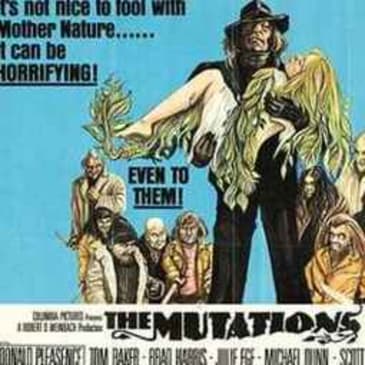
Blofeld AND Doctor Who in the same movie?!? How could this go wrong? Listen and find out how it does.
Hosted on Acast. See acast.com/privacy for more information.
[00:00:00] The battle for the mind of North America will be fought in the video arena. The television screen is the retina of the mind's eye. Therefore, the television screen is part of the physical structure of the brain.
[00:00:30] Okay, welcome back. Episode 35 of The Outer Reels. Jason is here. Sam. Sam. This movie, it looked a lot better in the trailer. Well, you've got Tom Baker, you've got Blofeld. It should have been awesome. I thought you would have liked some of the cost and everybody in this and everything else, but it's just... Yeah, I was excited when I found this movie, but not so much when we watched it.
[00:00:59] The movie we're watching tonight is called The Mutations from 1974. It... well, since Jason likes it so much, I'll let you describe... you can explain what it is. Well, I watched The Freakmaker, which is apparently the same movie. Which is actually a great title. I prefer that actually. It's not bad. Yeah. Let's... Basically, Mad Scientist trying to merge people and plants. That's your elevator pitch.
[00:01:29] That's all it is. Yeah. And it's 90 minutes and there's about 32 minutes of story. Yeah, I don't know what else to say. It really is that long with that little actual content in it. And again, from the trailer, I got pretty excited about it and I was pretty excited. I was like thinking this is something. I'm onto something here. I hadn't seen it. I hadn't heard of it. Yeah. And... Yeah. It's a...
[00:01:59] It's a slow burn. I wouldn't even call it a burn. It's just slow. It's just slow. I mean, you got Donald Pleasance as a mad scientist. Right off the bat. Great. Because he's awesome as always. That's the thing about Donald Pleasance too is he's just... He's just a professional. You know? Yeah. Yeah. He's just that classic actor feel, like just professionalism, which you just don't see anymore.
[00:02:25] He added a level of gravitas to the opening of this thing that in any other hands would have been terrible, including the American actor. I don't know if he's actually American or not, the guy with the American accent. Brad Harris. That man, he cannot act. At least he cannot deliver lines anyway. But I couldn't imagine him in the role of the professor. It just would have been brutal. Whereas Donald Pleasence, you believe, he believes everything he's saying.
[00:02:52] This movie is one of not really many movies about plants. I was trying to think of other movies with giant plants in them. There's not that actually many. Yeah, Little Shop of Horrors comes to mind. Yeah, I mean, that's got to be the first one, which is what, 1960 or early 60s or something? Something like that, plus a remake in the 80s. The Chrysalids has had a few different versions. Yeah, well, that's more like spores, right?
[00:03:21] Which you get, then your body snatches. No, the Chrysalids are plants. Oh, is it? Okay. No, sorry, not Chrysalids. Sorry, not the Chrysalids. Chrysalids is different. John Wyndham, same author. Day of the Triffids is what I'm thinking of. Yeah, I mean, the only other thing I can think of when I think plants is George Romero, Creepshow, and the opening short with Stephen King, Geordie Barrow, you know, and he gets taken over by the moss. Meteor shit.
[00:03:47] That's probably my favorite movie that has anything to do with plant attacks or mutated plants. And it's not even really. It's more like moss. Until now, right? Wow. I wanted to like this movie, and I thought there was going to have a lot going on, but I think like a lot of these, I learned fast that the plant is really like a subplot here at this point. The plant mutations and everything else. And it's more about the doctor.
[00:04:15] And also, there's a massive subplot with a bunch of carny freaks. Yes, there is. Some legit carny freaks, too. Yeah, they used some real traveling sideshow freaks at the time to film this. It's just boring. Like, I just didn't care about them. I wasn't interested in them. And I know they try and cross paths and, you know, sort of intertwine how, you know, the freaks are kind of like these plant creatures that Donald Pleasant's Dr. Nolter is creating.
[00:04:43] But this is directed by Jack Cardiff. Do you know anything about Jack Cardiff? Because I didn't. I didn't either, so I looked him up. Turns out he's a DP for the most part. Yes. And this was like the last movie he directed. He only has 15 directing credits, and this is his last directing credit. But the guy is worth a huge mention because he has way bigger importance in the world of film for being a cinematographer.
[00:05:11] And he has almost like 100 cinematographer credits. And two Academy Awards. He got one in 1947. And his second one he got in 2000, which was an honorary award, which I think is like the best award of all that you can get at that point. You know, I found this really interesting article in Time Magazine. It was from May 11th, 2009. And it was an interview with Scorsese. And he was saying how awesome Jack Cardiff is and how good his autobiography is.
[00:05:39] So it turns out he released an autobiography in 1996 called Magic Hour, The Life of a Cameraman. Even in his biography in 96, he's still calling himself just a cameraman. You know, he's quite humble. And so he's not mentioning anything about directing or anything in this. The book is dedicated to cinematography over directing. I think it's a bit more like he's a professional in that. And then he tried his hand at directing here and that, here and there. Maybe not so much from this movie.
[00:06:07] But like it's kind of like the same old story where we don't know the details or the time frame or what went wrong or the budget cuts or whatever. Like there could be a million reasons why this movie isn't as good as it is, you know. Yeah, I doubt this is the reason why he didn't direct anymore. I suspect he just decided he would prefer to be a, as you said, camera guy. He probably likes photography more than he likes directing. Yeah, and he had a huge part in the process of the switch from black and white to color too.
[00:06:36] He was heavily involved in the Technicolor process. I was considered a pioneer in the industry for spearheading and heading up the Technicolor process entirely and getting actually good results because it could look pretty weird and muddy. And I know we just talked about color film and stuff back in the 10th victim. But probably for a lot of guys listening, the younger people probably don't know much about Technicolor. But the way it got figured out, it was pretty simple. They would shoot it on black and white film stock.
[00:07:05] It wasn't color film when they were doing these tests. And it would take a prism and they would put it inside the lens and it would direct through the colors of light, your RGB channels, to multiple streams of film stock, which was the black and white film stock. And they would chip out an egg, like traditionally, and then after processing it like a black and white film, then they would dye each stream of it like your three color channels, red, green, blue.
[00:07:32] And then they would just like laminate the pieces back together and project it. And that's why sometimes it wouldn't look very good is because it all comes down to stabilization, right? Which, you know, stabilization meaning the little perforations on the side of the film, if the pinwheels and the registration on those aren't really good. The film can jump around. And you see it a lot on like late 70s, early 80s visual effects shots where they do optical printing because they have to reprint the same shot over and over.
[00:07:58] And it kind of drifts because the perfs in the film aren't perfect. And then they run around the way they were stamped. And so that's a whole other discussion we could have about. I got to talking to John Alexander a long time ago. And he was talking about how Kodak had the greatest emulsion and the best color you could get. But Fuji always made the best plastic. And the perfs were cut way more perfect than the Kodak ones.
[00:08:23] So you could get Fujifilm and you'd run it through an optical printer and you're stacking it and it tracked perfectly on top of it because it was cut so well. And the Kodak stuff would wobble around. But he said everybody obviously liked the color. So he came up with this idea to try and purchase plastic from Fuji and then take it over to Kodak and run it through their emulsion to get the best of both worlds. And then, of course, both companies got on to him. We're like, no way, you're not doing that. You know, by the way, he's an all visual effects guy that I've known for a really long time.
[00:08:52] He's a really wonderful gentleman. But the thing is, with these three channel with the Technicolor, when you're running three tracks of the film and you're laying it on top of each other, because the way the perfs don't align properly, it can look smudge and it can look weird. And that's like, you know, we talked about Wizard of Oz, which looked pretty good, but there's plenty of other versions of that that didn't look exacting.
[00:09:12] You know, almost sometimes it could look like, as an example, probably a visual example, like looking at a 3D image without 3D glasses, like the old blue red ones. Yeah, I noticed from his IMDb page he did, he's got a short called This Is Color that he was a cinematographer on from 1942. There you go. The same process at the time in the 30s was done with animation. And, you know, back when they would just draw the cell, photograph it from above and move on.
[00:09:41] But they would take three photos of the cell and then the same thing. They would process the negative and dye each cell red, green or blue and then layer it. So the early, early animation Fiddlesticks, which was like the guy, I can't remember the name of the animator, but he broke out from Disney and did his own thing. And it's considered like the first color cartoon. It's called Fiddlesticks and it's a cat playing a violin. And it's sort of known as the first color animation of all time.
[00:10:08] But, yeah, because they're not rolling picture with that, when they would photograph a single cell, they would just take it three times, cover the RGB. And then, of course, when you dye that frame, it works a little bit better with animation because you've got registration pins and everything on the cells. I think my point is that I probably prefer to talk about vintage film processing more than this movie. I could talk about that stuff forever. And as I've said, I started my career doing film movies, right?
[00:10:36] So, and I would hang down in the lab with the guys doing the processing and stuff just because I learned, you know, I had gone to school for essentially television broadcasting and not film. So I didn't know a damn thing about it. And then, of course, five years later, it was gone. No more film. Yeah, it died. I mean, and for how big and how much of it was going on, it fell so quick and so hard. It disappeared real fast. It's incredible how quickly it went.
[00:11:04] I do remember when Stargate, and they used to shoot on Super 35, and they had their budget. They were on Showtime, and they went to the Sci-Fi Channel, so they were getting a budget cut there. And so they didn't want to start shooting on 16 mil film. So instead, they switched to digital cameras like Lucas was doing with the prequels. You know, suddenly they're shooting on HD cam. And I was like, wow, this is the future. Of course, not realizing this is only high definition.
[00:11:31] And, you know, kiss 4K goodbye on Stargate remaster. Yeah, it was very interesting. And then, like, within two years, it seemed everybody was doing it, at least for TV. Yeah, call it on quick. And it's funny, too, when you think about it, because the big argument when that really happened was like, oh, it's so much cheaper. You save so much money. And, you know, we're back at the point now with shooting digitally. Like, sure, your setup is cheaper, but the gear is the same to rent.
[00:12:01] And storage is now costing you as much. Like, data storage is costing you just as much as scanning. So it kind of... Yeah, you're saving on the film stock, I think, essentially still. Although storage is getting up there in comparison. So it is still a little bit cheaper overall, I think. But not that much anymore. Yeah, exactly.
[00:12:22] Again, our director, Jack Cardiff, is a pretty awesome human in the world of feature film and especially the processes and his involvement with getting the push to color and the way movies look the way we do. So I might check out that book of his. It actually sounds really cool. But... It does, actually. I'll have to look that up. This movie, again, about plant mutations. Keep dragging us back to mutations. Yeah, it just starts out.
[00:12:49] And Dr. Nolter, Donald Pleasence, is teaching a class at a university. You're getting ahead of yourself, Sam. It starts off with a bunch of stop-motion film of plants growing. And that goes on for, like, a solid three minutes before you see your first credit. It's a long title sequence. Goes on for four or five minutes, I think, of titles before. But Donald Pleasence talking over the whole thing. But you don't really... You don't see...
[00:13:19] You get the odd intercut of him in the class. I actually have a note eight minutes in. When does this movie start? It's that slow, yeah. Yeah, and the footage of these plants, it's just, you know... I won't say stock footage. They probably shot it. But it's just time-lapse footage of things sprouting and growing. It's nothing fantastical by any means. Yeah, and then there's... He's talking about carnivist plants and stuff as well. And they show us each and every one. He's a plant nerd. That's what he is. He's just a total, like, bookworm plant nerd.
[00:13:49] And specifically, he... The way he's talking to the class is that he's specifically into predatory plants. And he talks about how they react. And he's kind of trying to sell the class on the idea that predatory plants are these super beings and can do all these things that humans can't. And we're pretty lame by comparison to what these plants do, really. Yeah, he's just... He's all about his plants.
[00:14:18] And the class is not that impressed. I know one of the students actually writes into his... This is a little bit later. He has a conversation back and forth with one of his students. And it's one of the guys in the movie, main characters. And this guy... Like, it ends with him just writing balls with an exclamation mark into his notebook. He does get on this thing. And he says in this lecture he's giving, You may think you were normal, but you were all byproducts of mutations.
[00:14:48] You're all freaks. This is a bit of a loaded statement because later... Based off how the movie goes, you find out there's a lot more to freaks and mutations and everything. But he's just all into anything in nature that's a mutation. And he talks about, like, mutations were created by choice. And he sort of mentions his theory is that, you know, these aren't, like, mutations that we think of that are made by people or done.
[00:15:15] Like, they're made by choice because they're made through evolution. And the only reason we exist are through all of these layers of mutations of cells and everything else. So, in a roundabout way, he's trying to prove that his plants are superior because they're the perfect mutation, I guess. Yeah. I don't know either. It's like... The basic gist of it is he's obsessed with combining human and plant DNA, I guess.
[00:15:44] Although he's not combining human and plant DNA. He's literally trying to graft plants onto people. I wish they did more about his actual research and work. Because we visit his lab a few times in the movie. But there's not much, really, that you get to see. You don't see him actually doing stuff. He's always got a needle and then we cut away. Like, you never see, like, his real theories or... Yeah.
[00:16:10] No, he's got a lab full of very plastic-looking plants as well. I think you should take that back, Jason. Because the man who designed these plastic plants that you speak of, giant Venus fly traps, they're like monster plants that he has. The gentleman who was involved in making those plants was Stuart Freeborn. And Stuart Freeborn, while he worked on the plant creatures for this movie, you would know him best because he ultimately was the guy who designed Yoda on Star Wars. Nice.
[00:16:40] That's a big one. So, he made a puppet, too. Good for him. One of the girls leaves the lecture and then she just starts walking through a park and then she's getting stalked by, like, a midget. It's a little person. There's a couple of them. Yeah. So, she's walking along and we have one of them putting up a giant poster. He's, like, painting on the lacquer or glue or whatever it is that they use to hold these things in place. And he stops and just, like, eyes her.
[00:17:08] Then another one of his buddies starts, little people, starts following her. And then she's, because she's walking through a park and then a fog comes out of nowhere and she gets scared. And then she kind of runs and then the fog's gone. And then there's, like, this little whiff of fog that kind of goes through the screen at one point. And then, but meanwhile, everywhere she goes, these guys appear to somehow get in front of her and then peek around trees and stuff, these two little people that are chasing her.
[00:17:37] And I'm just like, first of all, how are, you know, first of all, like, the first guy obviously cannot run. Like, he's not even trying. He's kind of limping as he walks, too. Yeah, he's a little bow-legged, too. So, exactly. So, how is he getting in front of her each time? Like, or is she just, like, doing some kind of weird-ass circle around this park? So, both of them are kind of catching up to her. And then all of a sudden, out of nowhere, Tom Banker shows up. And he's another freak. He's got a deformed face. And he just kind of covers her mouth and she passes out. I guess, or does he show her her face?
[00:18:04] I think he just probably looks at her and says, hey, does this rag smell like chloroform to you? Yeah. But, well, there's, because there's another point where he just shows his face. And the woman passes out. Yeah, because he has this freak-mutated face. And it's kind of bruised. It looks sort of, I guess you'd say fresh in a way. Like, he's having this, like, breakout. It doesn't look like it's something that he's grown up with. Because the skin looks totally different. That's how I read it.
[00:18:32] And doesn't it all look like something's just, like, resting over top of his face and it's clipped off in his hair? It's not. It almost looks like it's going to fall off at some point. Like, it's not. Yeah, so this character is, oh, while this is happening, there's this horrible experimental jazz playing the whole time. And as somebody who really enjoys movie scores, this one kind of irritated me when it was happening. Because it. No, it was not good at all.
[00:19:01] The part, the point I don't get, though, is that you let to believe that these two little people are helping Lynch, who's Tom Baker, catch this girl. But they can't be because they have nothing to do with. Like, you realize later in the movie, you find out they have nothing to do with anything that Tom Baker's doing. Yeah, I don't understand that connection either. I was a little confused by it later as we, as it reveals, like, their involvement and Lynch's involvement and Dr. Donald Pleasence's. Like, it was completely independent. And you said, I, I'm not sure.
[00:19:30] Maybe I missed something. But I think it's important to mention that during this time when this was being filmed, that Tom Baker was actually auditioning for Doctor Who. Yeah, he was going to say this is right before he becomes Doctor Who. So is this third? Which Doctor Who number was he at this point? He is four. Okay. Yeah. So he went from this to, you know, so he, I don't know much of Tom Baker's history, but he probably wasn't anybody before Doctor Who to most people, right?
[00:20:01] Yeah, no, I don't think so. And then he was basically the Doctor Who through the 70s and which is up until the modern era of the last 20 years. If you said Doctor Who, he was the one they thought of. Yeah. So we go to an airport and we meet Brian, who is the American. He's played by Brad Harris and Heidi, who is once again another Bond girl in one of our movies. Oh, I didn't catch that.
[00:20:31] Yeah, Julie, Julie, Julie Ege. Yeah. She was Her Majesty's Secret Service. Oh, there you go. The Bond movie everyone hates that I actually love. No, that would most likely be the George Lazenby one. That is on Her Majesty's Secret Service. Really? 69? I thought it was like. Lazenby is 69. Oh, yeah, you're right. No. Yeah, I think you're thinking Sean Connery comes back and does. Yeah, there you go. Which is essentially just a remake. I think. Right. Yeah. It most likely is. You're the Bond expert here.
[00:21:02] Yeah. And I am far from a Bond expert, but I do like my Bond movies. Yeah, I just looked her up. She is the Scandinavian girl in Her Majesty's Secret Service. And I totally miss that. But yeah, I mean, as you know, for me, all Bonds are just orbiting around Moonraker, as far as I'm concerned. That's the Bond movie. God, it's so good. Let's do this. Moonraker is literally just a remake of The Spy Who Loved Me from two years before. It's the same story.
[00:21:31] They don't go to the moon in The Spy Who Loved Me. They don't go to the moon in Moonraker either. It's a space station. But in The Spy Who Loved Me, the whole point is you've got a billionaire who wants to restart humanity by wiping it out. And to wipe it out, he steals a bunch of nukes from the U.S. and the Americans. And his plan is to start a nuclear war. Meanwhile, he has an undersea base that he's going to populate with his pretty people. And after the fallout's done, they're going to repopulate the Earth.
[00:22:00] In Moonraker, you have a billionaire who wants to wipe out humanity to restart it. This time, he's going to use a disease or virus or something that he's going to dump from space that's going to rain down on the Earth. And he's going to keep all his pretty people up in his space station until after this thing's done. It's the same story. And I tell you, if you watch the end of The Spy Who Loved Me, it says James Bond, which is from 1977, the same year Star Wars came out.
[00:22:30] Let's keep that in mind. At the end of The Spy Who Loved Me, it says James Bond will return in For Your Eyes Only. Wow. I didn't know that. For Your Eyes Only didn't come out until 1981. I never knew that. What did they do in the meantime? James Bond in space. Huh. Yeah. That's very cool. I didn't know. So Moonraker was like an installment just out of nowhere is what you're saying. Exactly. They're trying to capitalize on Star Wars. They thought space is hot. We got to put Bond in space.
[00:22:59] I mean, I love that boat with the hand glider gag too. That is so great. Yeah. Both of them even have Jaws in it. Yeah, they do. Yeah. And they're the only two movies with Jaws. I love when he's biting the cable car wheel. He's trying to slow it down. The Spy Who Loved Me. So good. Yeah. No, if you watch the end of The Spy Who Loved Me, it says James Bond will return in For Your Eyes Only, which tells you that they had already had, you know, For Your Eyes Only lined up and Moonraker.
[00:23:26] They just did to capitalize it because For Your Eyes Only can be. Knowing nothing about the history of the movie, just knowing that I liked it ever since I was a kid. It kind of reminds me of how Die Hard 3 went down where it was a script that was being kicked around for a while and Bruce Willis was signed to be in it. And then, you know, they were shopping for somebody for Sam Jackson. And then a producer got involved and was like, this could be a Die Hard movie. And they're like, sure, we'll just change it to McLean and that's it.
[00:23:56] But it was a standalone script. And then what about the lead guy? And they're like, well, let's make him Hans Gruber's brother. And, you know, that's the end of it. So it was just like a quick insert thing. I had heard that Starship Troopers was just a standalone as well. And it wasn't Starship Troopers. And then someone read it and said, there's a lot of similarities between this and that Heinlein book I read, like from the 50s.
[00:24:22] And so they thought they better cover their ass in the option Starship Troopers because the stories are fairly different. Oh, wow. I didn't know that. So the Starship Troopers novel basically has them in mini mech suits. Like they're in power. That comes back in Starship Troopers 3, which you haven't seen. No, you're right. The mechs do exist. I haven't seen anything. I know, but that's where it comes from in the book. Yeah. So then they just rejig the script to match all the names is what I had heard. I don't know how true that is, but it seems to be. I never knew that. I always learn something when talking to you.
[00:24:53] It's great. I learn things from you. I just usually forget them. As you should. You start talking about cinematography and stuff, which from you is weird. So you think I need attention. Anyway, instead of anything but casino, there should be anything but the mutations because we want to talk about anything besides this damn movie, apparently. Yeah. So after we get introduced to what's called the kids or the students, they're like next.
[00:25:22] They all look like they're in their 40s. Classic 70s style. So we get to meet those and then, you know, there's a subplot, this love interest thing. It's, you know, the only important thing I should say about the love interest subplot here is that Brian and Heidi are a thing. And the reason that's important is for later. But otherwise, it's, you know, not a big deal. Heidi's the Bond girl. Brian is played by Brad Harris. Brad's the American who can't act or be still on the reading.
[00:25:50] We finally get a look at Nolter's lab. And he's doing some tests and there's a tree and he's got a bunch of like IV lines into it. It's like a, some kind of houseplant thing. And it's like bleeding. Did you notice that? It's like, it's like scored and it's got like human red blood coming out of it. He doesn't really say it just shows that he's doing some weird experiments. But he takes an orange and he puts it in front of this laser, which looks very much like the laser from Honey, I Shrunk the Kids.
[00:26:17] Oh, I was, I was asking if it was like a Dr. No laser or sorry. It's actually probably a lot more like that, actually, to be honest. He zaps this orange and instantly ages it, I guess. And it's more time lapse like we see in the opening sequence. And it's just an orange getting old and it crumples and it gets a lot of fuzz. And then he like brings it to school the next day. And then his thing, the whole thing with the school is like, he's like, okay, here's this orange I have.
[00:26:44] He puts it in front of the class and then puts this machine in front of it and points it at it. And then it's just the reverse of the footage. Maybe I'm wrong, but I remember him doing the demonstration in class where he makes it go old and turn to fuzz. And then he reverses it like he does it both ways. And all I could think was like, you're just showing this off to your university students. Like this is a huge feat of feat of scientific engineering. And now it's all it is to show and tell.
[00:27:11] Everyone could put this in their home and revive their, you know, their rotted strawberry. I just remember sitting there and I just read, I don't care about this. What is this movie? Honey, I Shrunk Your Lunch. Nolter gives this lecture about the orange and how he can reverse these molecular things. And then Brian, who's essentially, he's not really a hero. I mean, that's another problem in this movie. There's no real hero, but he's like the main lead guy. So he gets an invite to Dr. Nolter's lab.
[00:27:41] And then we go back to Nolter's house, which is awesome, by the way. It's a cool, really cool looking old house. You get a little bit of an insight here. And again, I mean, Donald Pleasance is, he's a professional. He's incredible. And his deliveries are great. Like anytime he speaks, I'm like, okay, I want to hear what he has to say. And he taps in a little bit about his concern is the extinction of the human race. And I guess why he wants to do stuff with plants is because of how resilient they are.
[00:28:09] And he wants to create the perfect thing, which clearly would no longer be a human. So why are you worried about the human race if you don't want humans to? It's kind of strange, but I guess. Yeah. Mad scientist though. It's logic. And I think that's how they spin the whole movie, that his drive as this doctor is to stop the human race from disappearing. But he doesn't talk about why or when or anything. So it's a little thin. Yeah. No, it's very thin.
[00:28:38] But we should also point out that through all this, Lynch, who's Don Baker, is the one getting him these people that he does the experiments on. Yes. And Brian at this point isn't being experimented on. He's just getting a tour as a student, like on the nice side. Yes. But he does see a giant flytrap. And then Pleasance just turns around and picks up a rabbit. And he just feeds it to the plant. We leave this.
[00:29:07] And this is where we go into this whole subplot that I really didn't care about. But there's this like covered wagon style, like carnival cart. And there's a bunch of freaks that are inside it. And they're talking about seeing Lynch abducting the girl from the beginning. And I was like, oh, okay. Well, you guys are discussing when you were wheat pasting that flyer up there. Why did you start chasing her like a weirdo? Yeah. So that's why I thought that they were working together.
[00:29:34] But then we have this moment where there's an actual event at the carnival. And it's an actual sideshow. And we get introduced to all the mutants that are here. And this is 52 minutes into the movie. Well, and what I didn't expect is because they're all at the – the students all go to the carnival, all four of them. And the fifth one is the one is Bridget who's gone missing. And she's like the fifth friend from the beginning of the movie.
[00:30:01] She's the one that gets abducted by Lynch. And you find out she's been turned into one of these creatures. But they're all at the carnival. They're all having fun. They go to watch the freak show. What I wasn't expecting is that when they go in to watch the freak show, we get to watch the entire freak show ourselves. And it's like in its entirety we see everything. What happened to the version of this? A couple go to see a movie and then it cuts and they're walking out under the marquee.
[00:30:31] Like that's what we needed to see. Just like the great scene in the first Naked Gun where Leslie and Ilsa Priscilla Presley go on a date and they walk out from under a marquee and they're like laughing. He's like busting and he's got – there's like music playing. And it pans up and it shows Platoon was on the marquee. Yes, yes. That's good. I do love that movie. My favorite line is still, hey, nice beaver. It's had it stuffed. It just had it stuffed. And he hands down a stuffed beaver. Love Police Squad too.
[00:31:02] The show was great. That's one of those only one season. Why did it – Oh, not only one season. There's six episodes to Police Squad and that's it. I remember when it aired. I was watching that with my parents. We used to watch it every week with my parents. It was cut. It was canceled. It was like, are you guys crazy? This is genius. Some of the best things that aren't so genius. It's this movie. We're an hour – like I said, we're 52 minutes after this. And I'm like, well, where's my act break? What is happening? Like why do I care about anyone here?
[00:31:31] And none of that's clear and I certainly don't. But there is a point where Lynch is now chasing after Brian, one of the students. I know this is Tony at this point. Lynch is hunting down one of the students, Tony. He gets chased through a park and Lynch grabs him. We're back at Dr. Nolter's lab and he's on the bed. And again, this is the thing where we don't learn anything of the interesting parts of the movie.
[00:31:57] And Dr. Nolter just holds a syringe up and he's like, his cells and those cells are my plants. And he's got this IV and he mixes it all. And then he says like, a new species, an influenced mutation, it's going to work this time. It has to. So he's kind of just narrating that clearly this woman they abducted earlier didn't work out. We don't know how many times this has happened yet. So we're led to believe that this is ongoing a lot. Yeah. So what has happened with the previous one with Bridget is they basically dump her into the car.
[00:32:27] Weird plant lady. Yeah. Yeah. That they don't show you, you have to pay an extra 10 or 20 pence to go in and look at. The college students are all getting ready to go. And then they notice that the guy, the ringleader, small guy, the ringleader of like the circus kind of thing, is wearing Bridget's medal. I missed that. Yeah. Yeah. No, they make kind of a whole deal of it. And that's when, when he glances back and lurch is hanging out right behind them and he just kind of nods. No.
[00:32:56] You know, so he's like, oh, we're a full up and he doesn't let them in to go see the show because he's afraid to go. Because he knows there's something up with this woman because he knows him and Lynch are partners in the, in the circus. And I don't know how I managed to pick that shit up, but I did. Yeah. So yeah, there's that little giveaway. The thing is that these mutants that they're creating instead of killing them or whatever, for some reason he just dumps them at the freak show. And then, but we do see a shot of her being wrapped up in a white sheet and you see this head that looks like a plant woman.
[00:33:25] And they're like, she didn't make it like she's dead or something. And so. Yeah. She dies. And she just didn't like Lynch asked what happened. It's like, she just died. Like, yeah. And so this is the moment now where tells Nolter, like he sort of perks up a little bit as a character. And he says like, so if this one works, cause Nolter saying this one's going to work. And Lynch is like, if this one works and you're going to keep your promise with me and you're going to make it work for me.
[00:33:50] And because Lynch's face is all mutated, we're imagining that this is probably why Lynch is helping Dr. Nolter, like bring all these people because Dr. Nolter's offering, hey, I can fix you, you know, but you need to bring me these people to experiment. Whether that's his real goal or not, we don't know. But. Well, it seems pretty obvious that Nolter can't fix him. He's just pretending to. And Lynch just keeps bringing these people. Yeah, exactly.
[00:34:19] Nolter says with the characteristics of both plant and man, he will be a success. And Lynch says, oh, well, you know, why do I have to wait? And Nolter says, there's no way to cure him. Lynch actually makes a bit of a realization on that point. And he said, there's no way to cure me. He's like, this is just a way to keep Lynch, you know, keep me working for you, essentially. Like he makes some kind of realization there. And then Lynch goes on a stroll down to the brothel. Yes, he does.
[00:34:48] And the prostitutes on the street take a look at him like, no, no, no. And some of them are laughing at him. Some of them are in shock, you know. And so he's feeling worse and worse. So he finds a flyer that's offering dance lessons. It says young model gives dance lessons to strict tempo or beat or something like that. So he's like, I'll take that instead. And then he goes up there and then he has this interaction with her. Clearly she's a prostitute. And he just says, I want you to tell me you love me. And then she's just like, what?
[00:35:17] You know, she's like so casual about it. It's like, that's an extra pound. This is when Lynch calls after his interaction with the prostitute. Lynch goes and then he calls Dr. Nolter and tells him, hey, like the plant girl, who's the girl from the beginning, like she's dead. And Nolter says that, well, now you've got to find the latest experiment. It's on the loose. The new mutant that he's made is now escaped and it's ran out of his lab or something. It's some kind of escape.
[00:35:46] And you only know this by phone. So Lynch is like on the hunt to find this rogue plant creature. The sideshow people are like also shitty about Lynch. I don't know why, but they're turning on him, I guess because they know he's. Well, no, because they don't like him. He's, he's terrible. He's totally hopelessly mean to him. I just also want to interrupt and say the fact that you, you said at one point new mutant, the new mutants is one of the best. I wish I knew what that one was. New mutants. Sorry.
[00:36:13] Has that got anything to do with that movie with Thomas Jane from the mid 2000s called the mutant chronicles? Oh, no. Okay. No, I believe the mutant chronicles are tied to Warhammer 40. Oh, really? To be honest. Well, you would know. Yeah. Finally, something actually awesome happens in this movie is Dr. Nolter's latest creation is on the loose and there's a hobo who decides to take a nap under a bridge and the thing eats him.
[00:36:40] But when it eats him, it's like in a trench coat and it comes up and he's all drunk. It's whole chest is like a Venus flytrap, which is actually a kind of a cool gag, like a vertical like flytrap. I'm if you're a plant person who's listening, I'm probably messing up my botany. I'm not very good at what's one, but it's, it's one of the fly traps. I say Venus flytrap, it's some type of fly trap that has the vertical mouth on it. And the whole rib cage is that and it consumes this hobo and it's actually pretty funny. There you go.
[00:37:08] As long as it's not a Spanish fly because Bill Cosby got in trouble for that. Sorry. I'm sorry. Do not. Do never apologize for anything. I just, I just don't expect any apologies from anything about the man who was in Leonard part six. Here's the big moment where Tony shows up at his girlfriend's house. Now he's a mutant plant man.
[00:37:35] He's just eating a homeless person and he shows up at Heidi's house and he breaks into the house and she's showering. Heidi is in the bath. No, she's in the bath. And, and he climbs through her open window, but he's climbed. It's like an upper part of the window is open and he climbs over that. So this window frame is one of the strongest things I've ever seen. How do you know that Dr. Nolter didn't crossbreed him with a climbing plant? I guess so. But I mean, it's just, I assume.
[00:38:05] You're like, I get it. It's just not funny. Exactly. So, but no, he climbs over it. But my point is, is like the frame holding this lower window in place has to be one of the strongest things ever because unless Dr. Nolter made this guy suddenly only weigh about 12 pounds. Yeah. I don't know how that works either. Yeah. But anyway, it's quite funny. He climbs, climbs over and then kind of like a sash window. Just slide the bottom up and go through. It was kind of weird. Exactly.
[00:38:33] You know, she starts screaming because there's this like freak thing in her house. He covers his face with a towel and he's laying, it's right. He's like, don't, you don't look at me and everything. And he tries to tell her about the experiments on all the human beings. And then Lynch just shows up in the house and he kidnaps her. Well, he has her write it all down. So she does that. Yeah. And then she thinks that she hears at the front door someone there and she thinks it's Brian and she goes to run. Now, meanwhile, she's still just wearing a towel.
[00:39:03] You know, she goes to run, runs to Brian and but it's Lynch instead. Then Lynch actually, you know, is trying to hold her and she's struggling. And then he pulls back his scarf or his hat and shows her her face and she passes out. He doesn't even yell or anything like this is just this is his superpower at this point. Exactly. Women look at my face and they. And now we're back at Nolter's lab for the third time with a new person on the table.
[00:39:30] Again, we're not learning about anything that's as far as his science or how he does this. And he's just got a syringe and there he goes. And the only thing that I could come up with is that he says to Lynch, she said, now this one, she won't get away. And I was like, OK, so maybe this is finally the ticking clock. Maybe this is the thing that's supposed to speed things along. Brian is just arrived at the doctor's house.
[00:39:58] He's not at the lab, but he's showing up to find out what's going on because he's seen the note from Heidi. So this is the moment where you've got the doctor. He's holding the syringe in the air. He's like, it's time, you know, and Brian's coming into the house. So they're trying to build tension here, but it still just doesn't really fly. And then the dogs go nuts outside. Nolter's like says to Lynch, go out and find out what's going on. They have a fight. So this is they actually have a fist fight. Yeah. And this is the first piece of quote unquote action in the movie.
[00:40:28] And we are one hour and 24 minutes into this movie and now get a punch thrown. Yeah. And we should point out there's maybe two punches. It's not much fight. Like it's not, it's not much of anything. It's Sam calling it a fight is probably a gross over. Well, it's true because Lynch brains Brian with a, with a brick. Lynch brains Brian with a brick. That sounds like some kids rhyme. It's a little bit of alliteration. Yeah. So he's winning.
[00:40:58] And then this knife just shows up in his back and he turns around and another knife. And then it's like all of the carnies are there from the show. They're all scowling Lynch. And then Lynch is like, kind of like stumbling back towards the dogs, the attack, the security or the guard dogs are tethered on these wires. And he's stepping back closer and closer to the dogs. And then he's got a knife stuck in him and he's like yelling at the carnies. He's like, you're freaks. He's like, you guys are all freaks.
[00:41:26] And I'm like, well, he's a freak too, you know, but I think this is meant to be like a juxtaposition or something. And then a quick switch because then he pulls one of the knives out and he's looking at the knife and he says, don't you understand? I'm one of you. I'm like, well, two seconds ago, you just called him freaks. It's a really fast switch of opinion. I believe that if it was across the course of the movie and then he finds solace and he finds a home and he's like, oh no, I'm one of you guys. And yet this happens in like two shots. It's really weird.
[00:41:53] And then the dogs, he starts to slowly collapse because of the knife in him. And then the dogs just eat him. Yeah. I actually had a note here. Do the dogs eat them? Because the carnies kind of walk away and you just hear the dogs continue to bark. And I was like, but if they're eating them, why? Yeah, that's true. I don't know. I assumed they were doing it, but the carnies just do this weird thing where they're satisfied watching him die. And then they just like melt back away into the hedge. And that's like, that's their whole purpose, which never to be seen again.
[00:42:22] If they don't try and help Brian or Heidi or go in the house or do any of that, they're just there to kill Lynch. Well, they don't know what's going on inside the house, right? And they don't care. They're just, they just want to kill Lynch. They have to know that Dr. Nolter has been up to making some weird stuff that. I guess, but I mean, because their timing is otherwise suspicious. But again, they just kind of disappear and they're gone and that's it. And then we've got our Venus flytrap man coming through a skylight. This is the hero moment.
[00:42:52] This is the shot that was in the trailer that made me want to watch this movie. The best part is when he lands and he kind of rolls a bit, you can see there's this, there's like part of the rubber suit comes apart. Yes. You can see the white back of the guy inside the outfit. This is a big hero moment. Like, cause it's a big gloss, like terrarium skylight type thing. And he smashes through there and the creature still looks kind of cool. Like when he stands up, I still like the look of it as hooky as it is.
[00:43:22] He looks like a big flytrap. He's just started raging out on Dr. Nolter's equipment and he's trashing everything. Yep. So naturally something gets knocked over and a fire starts. And then he eats Dr. Nolter. Which is actually great. Kind of worth watching this whole movie just to see the shot of Donald Pleasant screaming as this chest flytrap like slowly closes around him.
[00:43:46] But I think the, which is great, but the better shot is they cut and they don't cut away. They just cut back to it. And then it poops out Dr. Nolter's body without any skin. And he's like, I got no eyelids. It's pretty good. Yeah. And then Venus flytrap man catches on fire and is dying. And then we start hearing the other plants start screaming because they're catching on fire because you realize they were people. I didn't connect to that, but that's makes total sense. Yeah.
[00:44:16] No, there was, there was, there were plants were screaming as, as they were burning. That's actually pretty neat. Yeah. Yeah. And then Brian comes in and finds his, his naked girlfriend on the table. She's not a plant. She saved the day. She's not a plant. Yep. But she, you know, she was close to it. Like everything was ready to go when, when his buddies smashed through the skylight. So he wraps her up and he takes her out to the car and the whole place basically just burns down. And then she's in the car. You know, she's, she's basically been unconscious this whole time and then wakes up to a raging fire
[00:44:45] and gets, you know, carried out and thrown into her car. And now she's horny. Like, like she's all over him. And I guess because she tells her she, like they make out and she said she loves him. She needs him. Yep. She needs him. She wants him. And then like a slow cut on her arm going around his back. And then we watch as it all transitions into green plants. Credits roll. Yeah. That shot. And to be clear, that's a locked off shot of, that's a locked off shot of her arm around
[00:45:14] his back, around the back of the car seat. And it's this slow. So you can see there's this matte line and they just do this dissolve to make it look like she's growing moss or. She's turning green and then there's some leaves. So I guess this is supposed to mean that that was Nalter's success or not, or she's just going to be another freak and it doesn't really matter. Swamp thing. Something's great. Dude, I loved that series on the Showtime. Was it Showtime that did that?
[00:45:44] Might have been. Yeah. Yeah. It was. No, it was Max. It was so good. And it was like expansive looking, but it was great. It was too bad to go canceled. I enjoyed that. Yeah. Yeah. I think they're doing it at the same time as Doom Patrol, which I still watch too. So how do you fix this movie? Like, what do you, what? Well, it needs more of a story. First of all, I think we've alluded to it already. I think the better story is more to do with the scientist and why he's doing what he's
[00:46:11] doing and how he's doing it and stuff other than just Donald Pleasant being awesome. And it's always like my biggest thing is like, he's clearly the villain and it's like, well, what does the villain want? And the simple answer of like, well, domination, you know, is just lame. In this case, his supposed theory is that he's worried about human civilization or humans not making it and trying to involve them into something that can survive.
[00:46:39] But we have no insight to that is the case with civilization. And it would be kind of more interesting if you set this on another planet and it was a small, you know, terraforming sort of outpost and they were dying off and this guy's just getting crazy because he's like some botanist in space and he's trying to do all this stuff to try and keep everybody alive. And, you know, there's just no reasoning behind why he wants to do this because it's not explored enough, which I feel like is the shortcoming.
[00:47:09] Well, I mean, and all villains are the hero of their own story. So, and they do touch on that. I mean, he doesn't want to save humanity. It's just, he's messed up with the way he wants to do it. But again, as we've been saying over and over again in some of these movies lately, there's just not enough story here for it. And they had room to have story for, for how long it is with nothing happening. They have plenty of time to develop, even if it's just dialogue. We didn't need to watch that car drive all the way down the street, looking at it from both angles.
[00:47:40] You know, it's like an intro with this, with the time, with the time lapse of the plan. It's like, yeah, you can fill it with so much more stuff in it, even if it's people reading or talking theory or just, yeah, more stuff of pleasance. I don't know. It, that, that opening the way it was, even as I'm watching, I'm going, this screams a movie that was making up time. Did you know that Dr. Nolter's original typecast for this was Vincent Price? Oh, I could see that.
[00:48:07] I could see this tracking really well as like a sixties Vincent Price movie with some more interesting stuff. And I feel like I say a lot, but this movie feels older than it is. And if this was 10 years earlier, I'd probably give it a bit more of a free pass on some of these things. I mean, it's got a little bit of like Island of Dr. Moreau in it and stuff too. And that could have been like with Vincent Price a really interesting day.
[00:48:31] Especially because Donald Pleasant specifically said that he came up with the idea to play Dr. Nolter in a quote low key manner, which I mean, he's pretty low key, but it's like, that's a, for this movie. I mean, I could see that if this movie was crazy, but because it's such a low, slow movie already having him or I feel like the dynamic would be him to be crazy.
[00:49:00] At least it would give it a shift or something. Yeah. I think the movie, if the movie's crazy around him and he plays the low key the way he does, it would be way more unnerving and something a lot better. Yeah. So I think, I think he had the character. I just don't think the movie supports him. This is a six week shoot. I don't know what they did for the other five weeks, but yeah.
[00:49:25] I mean, uh, the, the cruise I work with, we could have easily done this in probably 12 days. It's just feels there's just nothing here. There's other than his lab, there's not even set construction. You know, there's just nothing. There's a reference in here directly to the 1932 freaks. A bunch of the sideshow guys are looking at Lynch and they say like, we accept you. He's one of us where they're trying to like bring him, you know, and that's an exact quote
[00:49:54] from the original freaks film, which I thought was some, some kind of neat thing at least. Yeah. So back to Jack Cardiff, as we were, you mentioned, you're like, this was his final film, you know, as a director, even though he was an incredible cinematographer, as we established, uh, this movie was considered a critical disaster and a massive box office flop. And it was shown on a lower half of a double bill in the UK.
[00:50:21] So, you know, when it finally came time, it didn't even get a proper opening. They just tacked it on, on to a double billing. And, uh, it was almost a year after they'd actually put it in the can. And I think they just didn't know what to do with it and what were they going to, you know, and they were just sitting on it and, you know, they didn't want to spend money marketing it, I guess. And then they finally found a slot somewhere that they could buy, that they could put it on. And just let me inside joke where Robert Weinbeck was the producer.
[00:50:50] He mentioned to Donald Pleasance that his performance about the screams he was doing when he was being eaten. And he, he was just, he just mentioned it to him in Pleasance, just being somebody who has a lot of sense of humor. He was like, what are you talking about? He's like, that's my best work ever. And, uh, but, uh, Weinbeck said that he was just really great to work with and down to earth and a terrific sense of humor.
[00:51:17] Like all the things we expect to know about somebody like that, like a professional once again. So it's just, I just miss people like that who they take a role. They know it's hokey. They give it their best, but they still also take shade if somebody throws it because they know it, you know, they're not like, well, look, thanks man. I'm, uh, I apologize for this one. This took me by surprise. I was expecting this to be a lot better. I, I'm not even crazy about the poster.
[00:51:44] I would just say for any guys listening, check out the trailer because it's pretty fun. The score is forgettable. What's kind of annoying cause it's, you know, weird, crazy jazz, but the movie has a bit of a cult following. I mean, it has a Blu-ray now, you know, which is, I have to imagine that it hasn't because of Pleasance. If he wasn't in it, I can't see somebody doing that, but there's nothing really stand out
[00:52:11] in it and, uh, you know, I'll have my revenge, I guess next week because I don't think you can do like what I've got lined up. Can we just please watch a good movie? Yeah. Well, we'll see. I don't know what to expect from this. Uh, 1954 is devil girl from Mars. We'll see. Sounds great. I'm already excited. It'll be better than this. As always, we watch these movies so you don't have to, and this is definitely one of them. Poke around, look at some images again, watch the trailer.
[00:52:38] Or I'm sure you can find a few things to throw up. Yeah. Oh yeah. There'd be a lot of plants eating people close going up there, but that's really all that's in this movie. So, uh, I wouldn't recommend anybody sit through this cause it's a bit of a slog, but you know, that's why we do it. And as always still either way, anything, anything, but casino, but casino and, uh, appreciate it.
[00:53:04] And then we'll see you next week for another devil girl from Mars. Looking forward to it. Thanks man. Appreciate it. Thank you. Bye. Therefore, whatever appears on a television screen emerges as raw experience for those who watch it. Therefore, television is reality and reality is less than television.